Notice of Commencement (NOC) in St. Johns County: What Contractors Must Know in 2026

In Florida, a Notice of Commencement (NOC) isn’t just another piece of paperwork — it’s a legal requirement that protects property owners, contractors, subcontractors, and suppliers. In St. Johns County, understanding how NOCs integrate with building permits, plan reviews, and inspections is fundamental to keeping projects on schedule, avoiding fines, and ensuring compliance with state and local laws.
Failure to file, record, or manage an NOC correctly can lead to inspection refusals, permit delays, or even disputes over lien rights. That’s why contractors need a comprehensive grasp of how St. Johns County notice of commencement works — from when to file it, how to record it, and how it interacts with NOC permits in St. Johns County.
In this blog, we’ll walk through the complete landscape of NOCs in St. Johns County Florida in 2026, highlight common pitfalls, offer best practices, and show why Permit Rockstar — with its capabilities in private plan permit reviews — is the smartest choice for contractors who want faster approvals and fewer headaches.
What Is a Notice of Commencement (NOC)?
A Notice of Commencement is a legally recorded document in Florida that:
- Officially notifies the public that construction has begun on a property.
- Establishes the official start date of a project for lien rights.
- Signals that the owner or contractor is now responsible for project compliance.
- Is required before issuing or receiving certain building inspections.
An NOC clarifies who is financially responsible for the work and protects subcontractors and suppliers in the event of non-payment. It also acts as a trigger for some permitting requirements — especially NOC permits in St. Johns County involving higher-value projects.
In 2026, the basics of NOC filing remain rooted in Florida Statutes (especially Chapter 713), but local enforcement and interaction with building departments continue to evolve — especially in fast-growing counties like St. Johns.
Important timing note: An NOC does not automatically prevent permit issuance in all cases; however, many jurisdictions including St. Johns County require the recorded NOC to be on file before the first inspection can occur. As a result, contractors typically record the NOC prior to requesting inspections to avoid delays.
When Is a Notice of Commencement Required in St. Johns County?
In St. Johns County, contractors must file a Notice of Commencement when:
- A project’s value exceeds $2,500 (statewide threshold under Florida law).
- Private inspections or special inspections are required.
- The project involves structural modifications.
- Subcontractors or suppliers will be involved.
Important HVAC clarification: For HVAC system replacements or installations, Florida law generally requires an NOC when the project value exceeds $7,500 rather than the standard $2,500 threshold. Contractors performing mechanical system work should verify the total project value and confirm whether the higher threshold applies before scheduling inspections.
Why this matters: While permits may sometimes be issued before an NOC is recorded, St. Johns County typically requires a recorded NOC before the first inspection is scheduled or performed. If the NOC is not on file when the first inspection is requested, local officials may refuse inspections or withhold occupancy certifications.
Why this matters: Filing an NOC before pulling a permit or scheduling the first inspection is often a condition for permit issuance. If the NOC is not on file when the first inspection is requested, local officials may refuse inspections or withhold occupancy certifications.
Important to note: Even if a homeowner is performing some of the work, an NOC may still be required when a licensed contractor is involved, especially for trade permits.
How to Prepare and File an NOC in St. Johns County
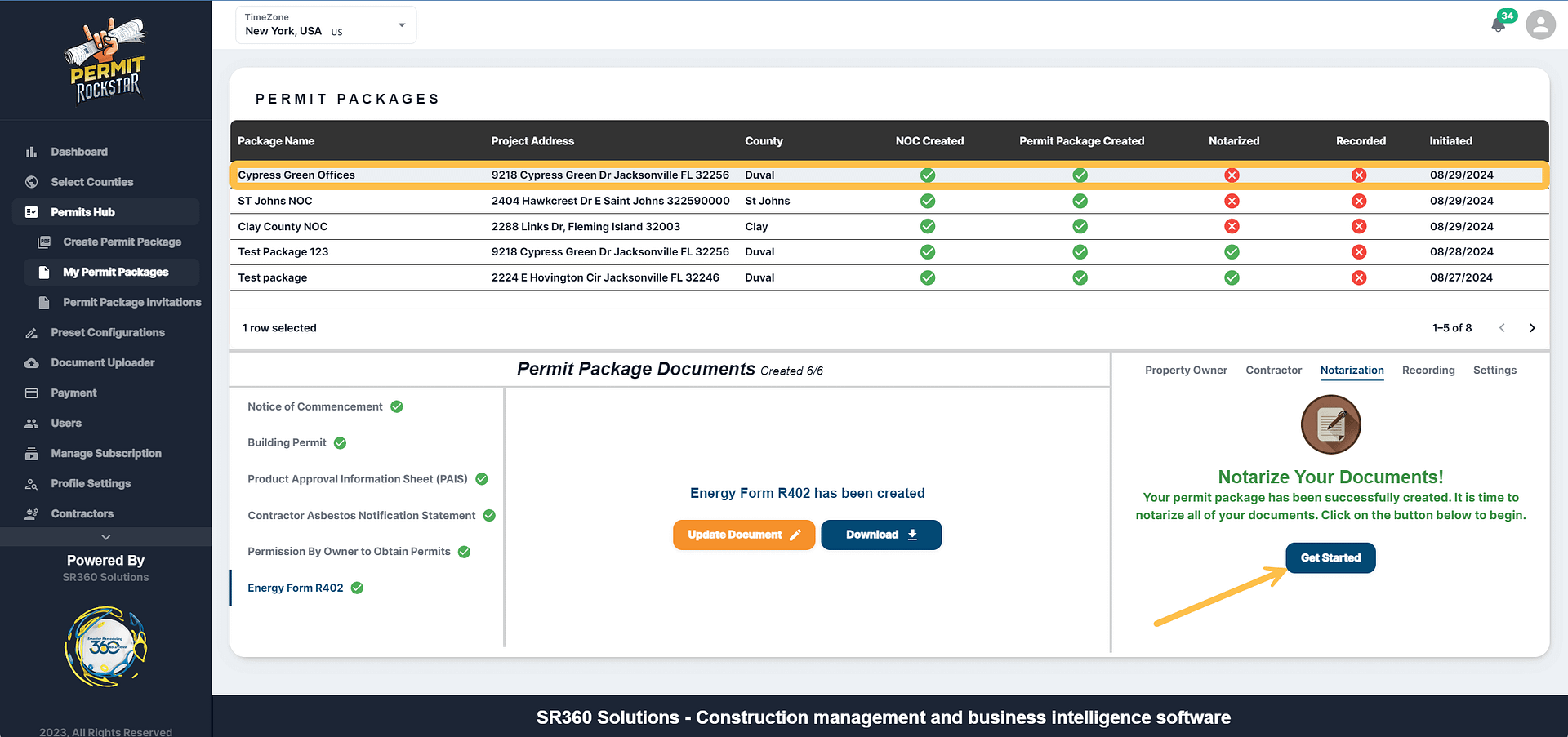
Filing your St. Johns County Notice of Commencement (NOC) correctly can significantly streamline your permitting workflow and prevent avoidable permit delays. Below is the standard step-by-step process most contractors follow in 2026 — and how PermitRockstar.com can help handle the paperwork and submission for you.
1. Complete the NOC Form Accurately
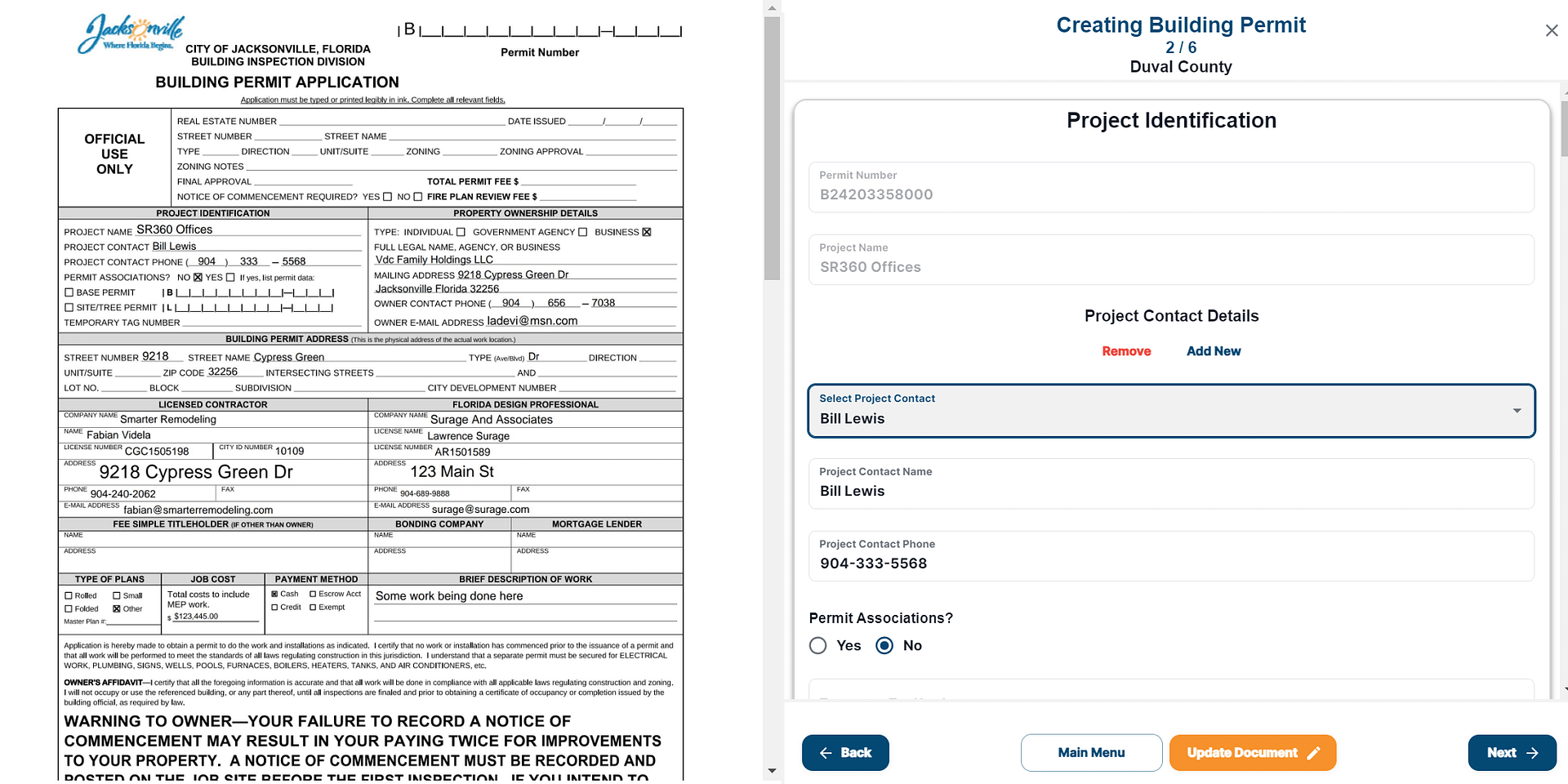
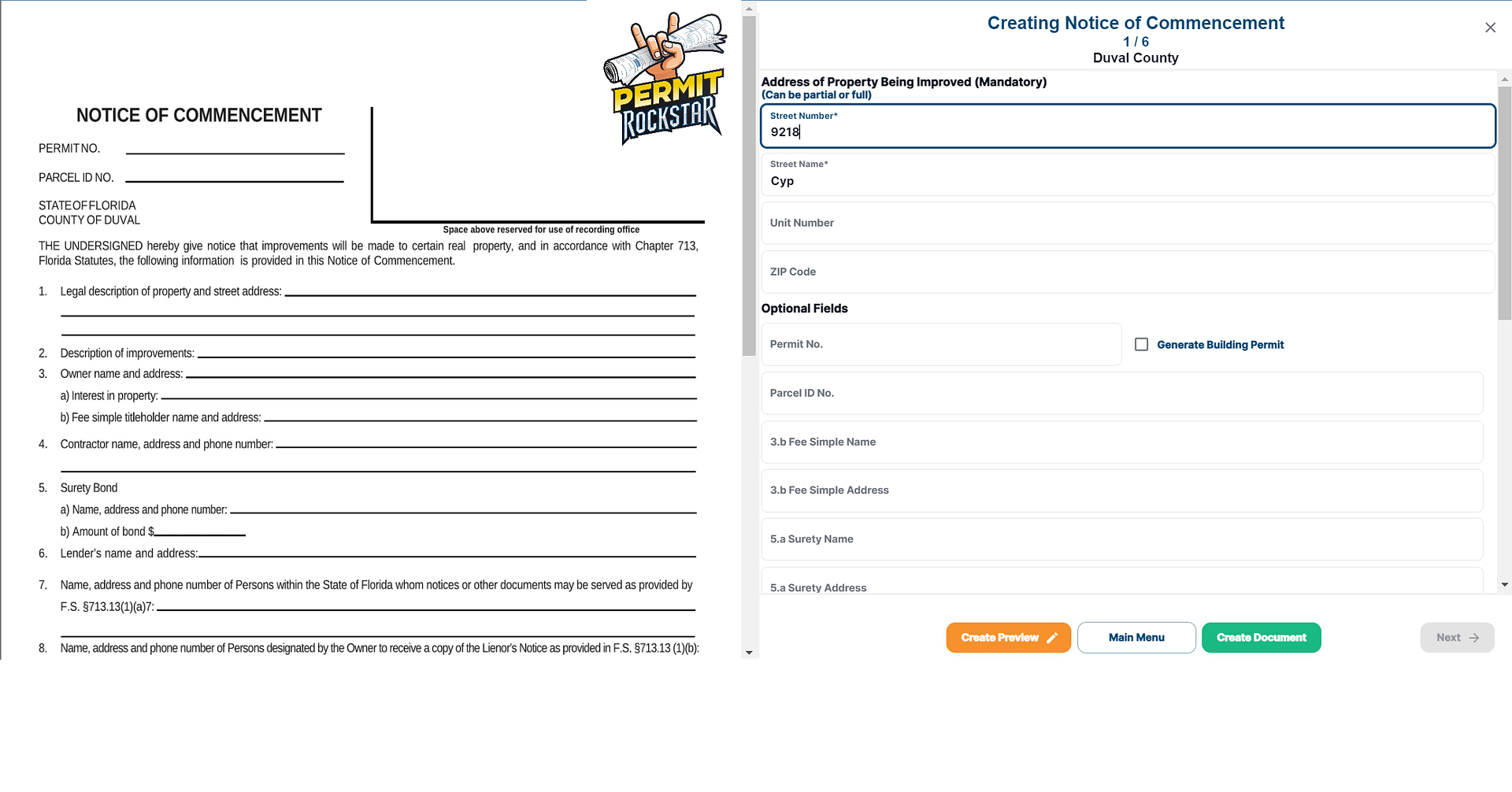
A Notice of Commencement generally requires:
- Legal description of the property
- Owner’s name and contact information
- Contractor’s name and license number
- Surety information (if applicable)
- Name and address of the person signing the contract (often the owner)
- Description of the work to be performed
- Estimated start date and completion date
- Notary acknowledgment
Tip: Many permit delays occur because of incomplete or inaccurate information — especially legal property descriptions. Matching the legal description exactly to county property records prevents rejection.
How Permit Rockstar helps: We can prepare the NOC for you, verify the property details, and ensure the form is completed correctly before it’s notarized and recorded.
2. Notarize the Document
An NOC must be notarized — and in 2026, many Florida counties (including St. Johns) allow remote online notarization (RON), which saves contractors trips to the county clerk’s office.
How Permit Rockstar helps: We can guide you through the notarization requirements and help coordinate remote notarization when it’s available and appropriate.
3. Record with the St. Johns County Clerk of Court
Once notarized, the NOC must be recorded with the Clerk of the Circuit Court in St. Johns County. This recording provides legal notice to the public and other stakeholders.
How Permit Rockstar helps: We can handle the recording process for you and confirm the document is officially recorded so you have proof for your permit file.
4. Provide Copies to Relevant Parties
After recording:
- Submit a copy to the building department
- Keep a copy on site
- Provide copies to subcontractors and suppliers
This ensures inspections aren’t held up and lien rights are properly protected.
How Permit Rockstar helps: We can include your recorded NOC as part of your permit submission package and ensure the building department receives the correct recorded copy.
5. Understand the NOC Expiration Timeline
In Florida, a Notice of Commencement generally expires one year after the date it is recorded unless the document states a different expiration date. If work continues beyond that period and the project is still active, a new NOC may need to be recorded to maintain lien protections and inspection eligibility.
Contractors should monitor the NOC timeline on longer construction projects to ensure the document remains valid throughout the duration of the work.
Want to Skip the Paperwork?
If you’d rather not deal with NOC prep, recording, or permit submission steps, Permit Rockstar.com can manage the Notice of Commencement process for your St. Johns County construction project from start to finish. Contact us now to schedule a demo!
NOC Permits in St. Johns County: Key Considerations
“NOC permits in St. Johns County” are not a separate permit category — instead, the NOC functions as a prerequisite to certain permit actions or inspections.
Here are the key elements contractors should understand:
NOC and Permit Issuance
In many cases — especially for larger projects — St. Johns County will require an NOC to be filed before issuing the permit. This is because:
- The county uses the NOC to verify the start of work.
- It confirms project responsibility.
- It ties into the inspection scheduling system.
However, in practice the most consistent enforcement occurs at the inspection stage rather than the permit issuance stage. Contractors should ensure the NOC is recorded before requesting the first inspection to avoid delays or rejections.
If the NOC is not on file at the time of permit issuance, you may be forced to:
- Delay inspections.
- Return after hours to resubmit documentation.
- Face costly project hold-ups.
NOC and Inspections
For critical trade inspections (roofing, electrical, mechanical), inspectors often will ask for an NOC number or confirmation of filing. Without it, inspections can be denied.
This is especially true when trades are pulled separately — e.g., a generator electrical permit versus a building permit — requiring coordinated NOC documentation.
NOC and Project Value Thresholds
While Florida’s statutory threshold for filing an NOC is $2,500, with variable exceptions, many contractors choose to file for any project where multiple trades are involved, especially if:
- Florida HVAC projects have a $7,500 threshold
- Lien rights may be impacted.
- Insurance documentation is required.
- Multiple subcontractors are involved.
This proactive approach avoids disputes and protects overall project integrity.
Avoid These Costly Mistakes
Understanding how to file is only half the battle — doing it correctly is what keeps permits and inspections moving. Here are the most common contractor mistakes:
X Filing NOC After Permits
Some contractors incorrectly pull permits first and file the NOC later. In St. Johns County, this often results in:
- Inspection denials.
- Permit holds.
- Project scheduling chaos.
X Incomplete Legal Property Descriptions
One of the leading reasons NOCs get rejected or delayed is an incorrect legal description. Always pull this directly from the property deed or tax records.
X Missing Notarization or Recording Steps
Failing to notarize or record the NOC correctly means it’s not legally filed. Inspectors and permit clerks will flag this immediately.
X Not Providing Copies to all Stakeholders
Even if the county has a record of your NOC, you still need copies on site and with subcontractors or suppliers. This helps when inspectors ask for proof at the job site.
Private Plan Permit Reviews in St. Johns County: The Game Changer
One of the biggest causes of permit delays — including NOC permit hold-ups — is incomplete plan review. A traditional city plan review often flags missing details only after submission, forcing contractors into a correction loop. That’s where private plan permit reviews St. Johns County in Northeast Florida come in.
What Are Private Plan Reviews?
Private providers are licensed engineers, architects, or qualified firms authorized under Florida Statute 553.791 to perform plan reviews and inspections in place of the local building department. They complete the same technical code review the city would normally perform, but they are not bound by municipal workloads or staffing limitations.
Important clarification: The use of a private provider does not create or trigger the requirement for a Notice of Commencement. NOC requirements are determined by Florida lien law and project value thresholds, not by whether a private provider performs the plan review or inspections.
Benefits of Private Provider Plan Review
- Faster turnaround times
- Predictable review schedules
- Direct communication with the reviewer
- Fewer rejections due to clear guidance
- Flexible coordination and digital submissions
- Stronger project control for tight timelines
Read more details about Private Provider Plan Review in our blog: https://permitrockstar.com/private-provider-plan-review-vs-city-plan-review-in-florida-what-contractors-need-to-know/
Contractor Stories: Real Outcomes with Permit Rockstar
Project #1: Roofing and NOC Delay Avoided
A roofing contractor in St. Augustine normally saw a full week of delays due to NOC submission errors. Using Permit Rockstar’s pre-submission checks and private plan review, they filed a perfect NOC and permit package — and received inspection scheduling within 24 hours of submission.
Project #2: Window Replacement with NOC Required
A home remodeler planned a major window replacement that triggered multiple trade permits including electrical. Using Permit Rockstar, the contractor ensured the NOC was recorded before permit submission — and all trades were scheduled back-to-back without delay.
Project #3: Generator Install Without Hold-Ups
An electrical contractor struggled with fuel line documentation and NOC coordination. Permit Rockstar helped bundle all documentation, pre-verify approvals, and expedite review. The job passed all inspections with no rework.
Ready to experience your own project success story? Contact Permit Rockstar today to streamline your NOC filings, permit submissions, and plan approvals — schedule a demo to learn more!
Frequently Asked Questions (FAQs)
What happens if I don’t file an NOC before pulling permits?
In St. Johns County, the county may refuse inspections, flag your permit, or delay issuance until the NOC is properly recorded.
Is an NOC required for small repairs?
Typically, any project valued over $2,500 should have an NOC recorded. However, local enforcement may request it for major repairs involving multiple trades. For HVAC system replacements or installations, Florida law generally requires an NOC when the project value exceeds $7,500 rather than the standard $2,500 threshold.
How long does it take to record an NOC?
With accurate documentation, recording at the Clerk’s office can be completed in the same day or within 1–2 business days.
What if the legal description is incorrect?
The county clerk will reject the filing. Always pull the legal description from official property records.
Can I file the NOC online?
St. Johns County increasingly supports digital filings but still requires certain notarization and recording steps.
Does Permit Rockstar file my NOC for me?
Permit Rockstar helps you prepare, review, and track your NOC filing — including managing necessary recordings and uploads.
Do I need separate NOCs for separate permits?
Typically, one NOC per project is sufficient, but always confirm with the county if scopes of work are large or distinct.
How does private plan review speed approvals?
It catches errors before county review, significantly reducing correction cycles and approval time.